Starch is a ubiquitous material in the plant world and is the means by which plants store energy. We humans find it extremely useful also, and use it as food, as a food thickener and for many other purposes. Examples include stiffening clothing, binding tablet granules together and acting as a disintegrant in tablets. It has unusual properties. Dry, it is a powder. It readily forms suspensions in cold water, but on heating it gels and can be used as a thickener or as a type of glue. This ability to gel is fundamental to its use in cooking. It is stained blue by iodine, although only in the cold - if you heat an iodine stained starch gel, there comes a point when the colour vanishes. Under the microscope, starch has a characteristic structure, which is best observed using crossed polarising filters. Under these conditions, starch grains show a characteristic "maltese cross". Starch grains from different plants show different shapes and sizes and this can be used as the basis for identification of the starch type.

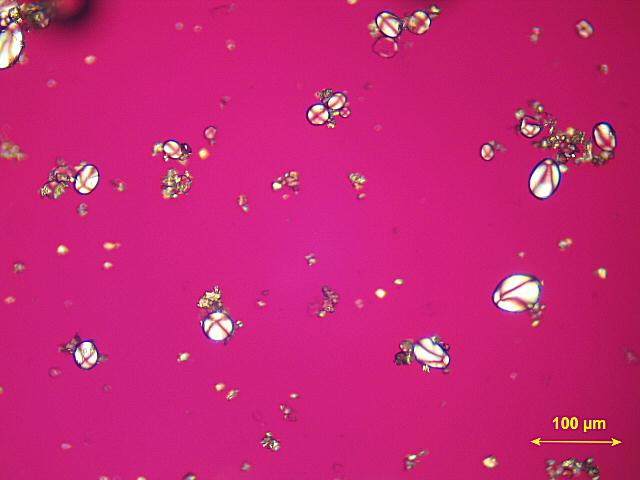
Here is a picture of potato starch in polarised light. This image is to the same scale as the maize starch at the top of this page and you can see that the two starches are very different in size and shape.
|
|
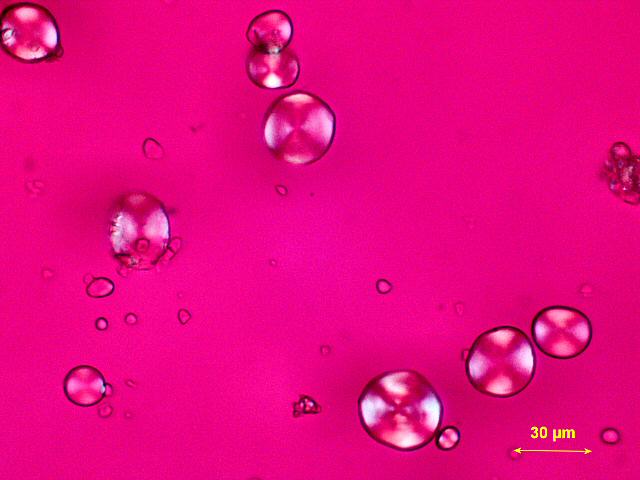
Potato starch at higher magnification in polarised light. |
|
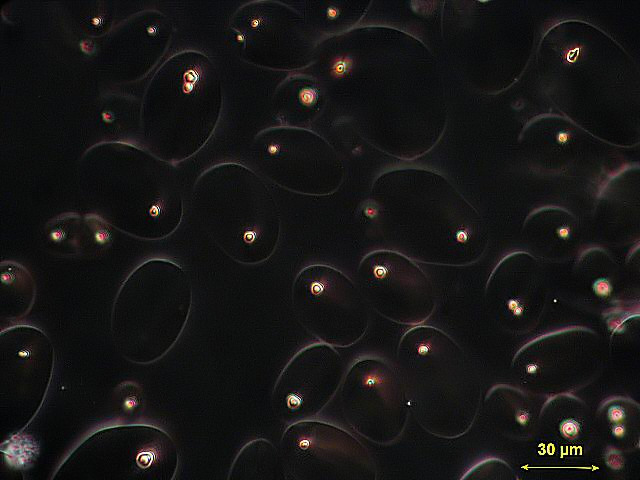
The drawing of potato starch above is from Jabez Hogg's book History of the Microscope 6th edition, 1867, and clearly shows the characteristics of potato starch, including features common to all starches: the hilum and the layers around this point that construct the grain. It is at this point that the cross seen in polarised light has its centre. Below is an image taken in circular oblique lighting (COL), almost set to darkground, showing each hilum as a bright spot.:
|
|
|
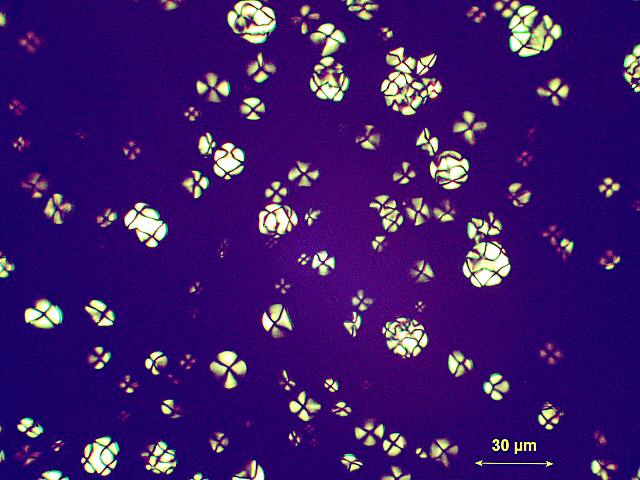
Aspirin Dispersible tablet in waterFinally, for this section on potato starch, here is an image taken of an Aspirin Dispersible tablet in water. This effervescent tablet used potato starch as a disintegrant. The small particles are probably talc, which is used as a lubricant during tablet compression. |
|
Here is a selection of other starches for comparison
|
Maize Starch showing polygonal grains and well defined hilum |
|
Oat starchThe grains are very small and tend to occur in clumps |
|
Wheat StarchRounded separate grains |
|
Sarsaparilla StarchJust look at how it forms little balls of granules!
|
|
When I find some, I want to add rice starch, which has clusters of very small polygonal grains.
|
The pictures on this page were taken using a Watson Bactil Binocular microscope and a Canon Powershot S50 digital camera.